4.2. Three-Dimensional Instabilities
Electrohydrodynamic jets may transition from a stable, approximately axisymmetric cone-jet to asymmetric droplet emission, lateral oscillations and whipping as the applied electric potential increases.
These effects cannot be captured by an axisymmetric model, which constrains the jet centreline to remain aligned with the capillary axis. Fully three-dimensional simulations are therefore required to resolve the radial motion and its temporal development.
The simulations presented here use the numerical methodology described in the Modelling chapter.
4.2.1. Problem Definition
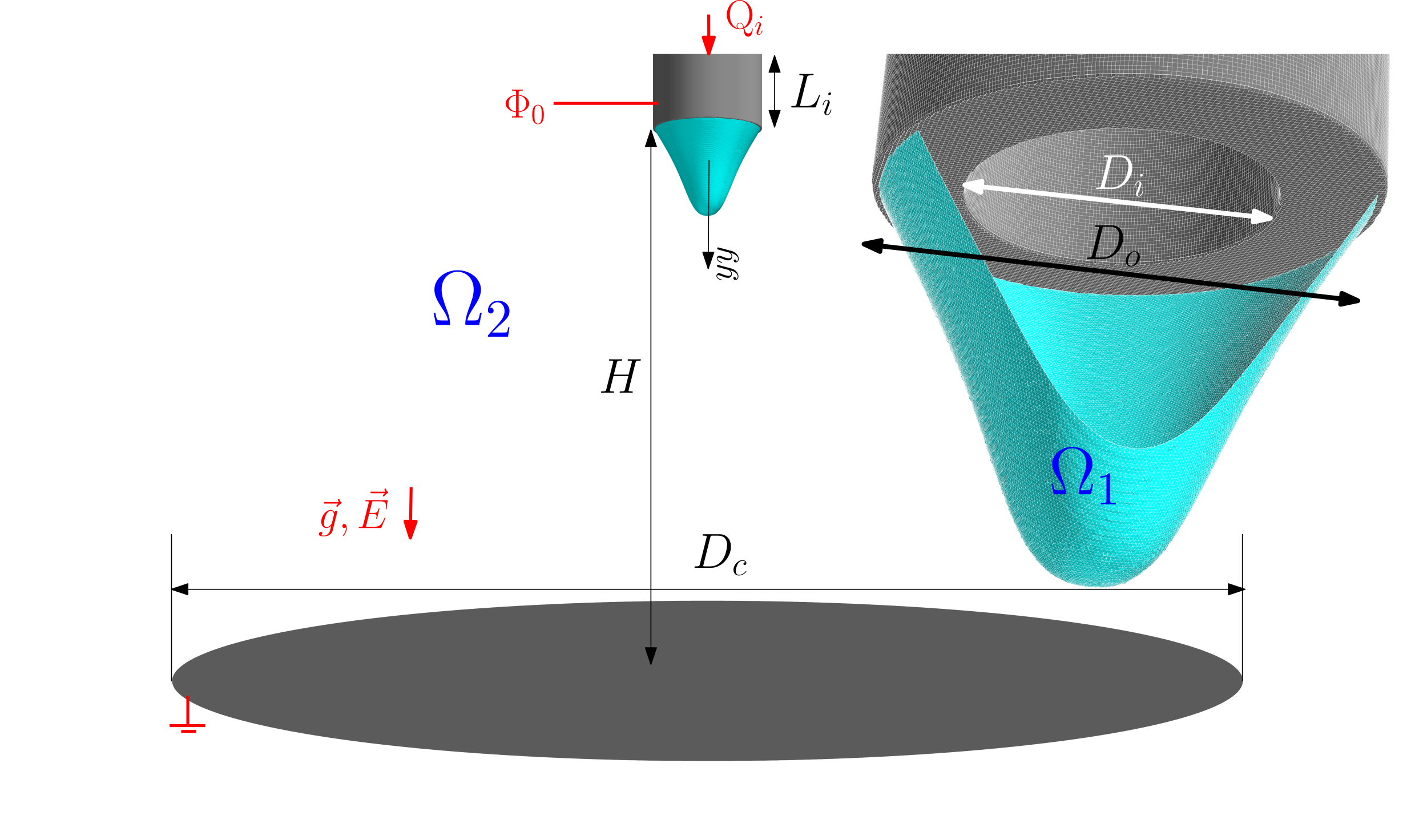
The configuration consists of a metallic capillary facing a grounded collector. The capillary has an internal diameter Di = 160 µm, an external diameter Do = 260 µm and a length L = 300 µm.
The capillary tip is positioned H = 1.5 mm from a collector with diameter Dc = 5 mm. The capillary is maintained at a potential U0, while the collector is grounded.
The electric field deforms the liquid interface and drives the formation of the Taylor cone and the emitted jet.
4.2.2. Electric Capillary Number
The intensity of the electric forcing relative to surface tension is characterised by the electric capillary number:
Here, \(\varepsilon_0\) is the vacuum permittivity, \(D_i\) and \(D_o\) are the internal and external capillary diameters, \(E_0\) is the characteristic electric field, \(U_0\) is the applied potential, \(H\) is the capillary-to-collector distance and \(\gamma\) is the surface-tension coefficient.
At low CaE, surface tension suppresses lateral disturbances. As CaE increases, electric stresses become sufficiently strong to amplify non-axisymmetric perturbations.
4.2.3. Whipping Dynamics
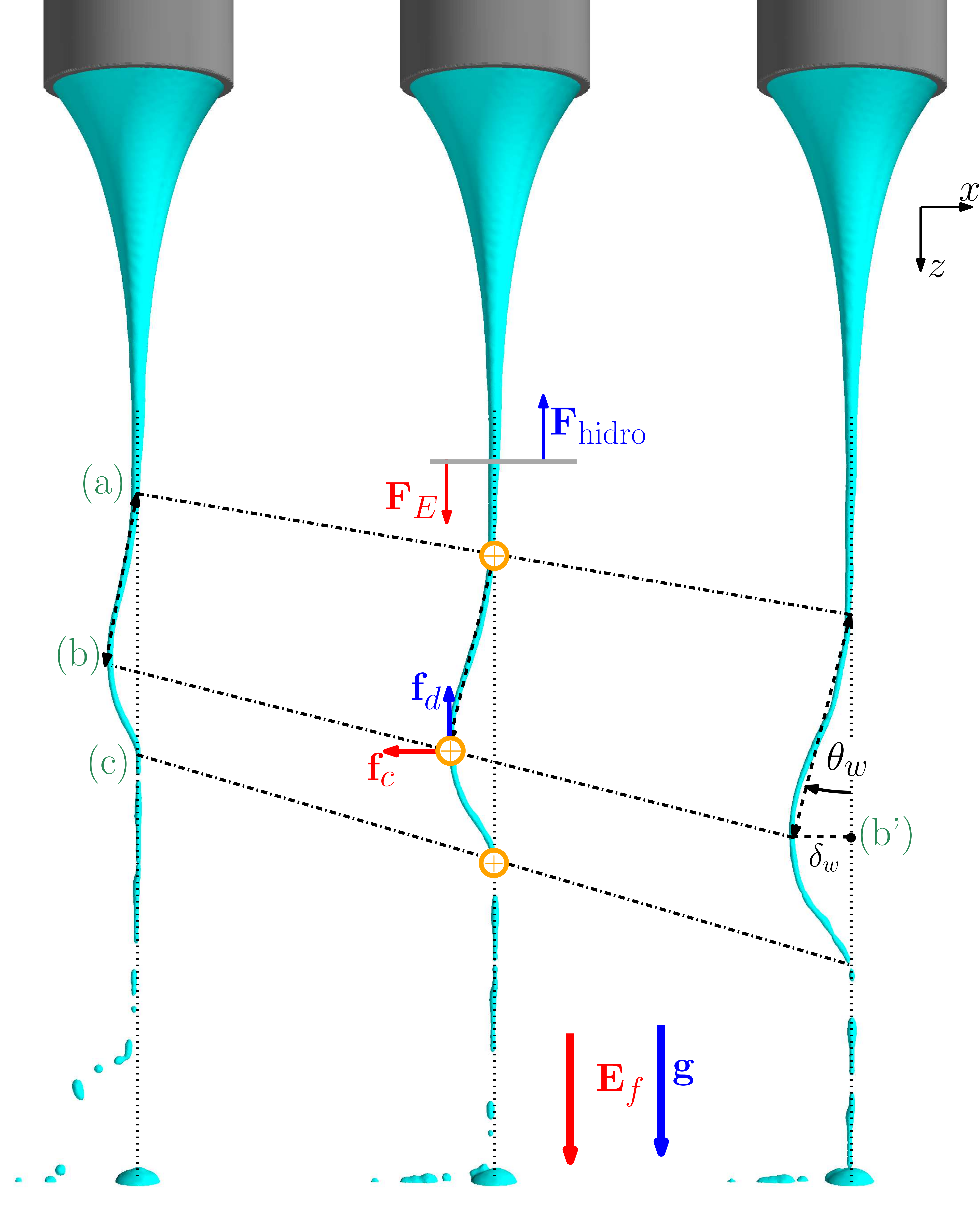
A small lateral displacement changes the electric-field distribution around the jet. The resulting asymmetric electric stresses further displace the liquid, creating a feedback mechanism that amplifies the initial perturbation.
The disturbance propagates along the jet towards the collector. Its amplitude increases as electric stresses overcome the stabilising effects of surface tension and viscosity, producing the characteristic whipping trajectory.
4.2.4. Transition Between Regimes
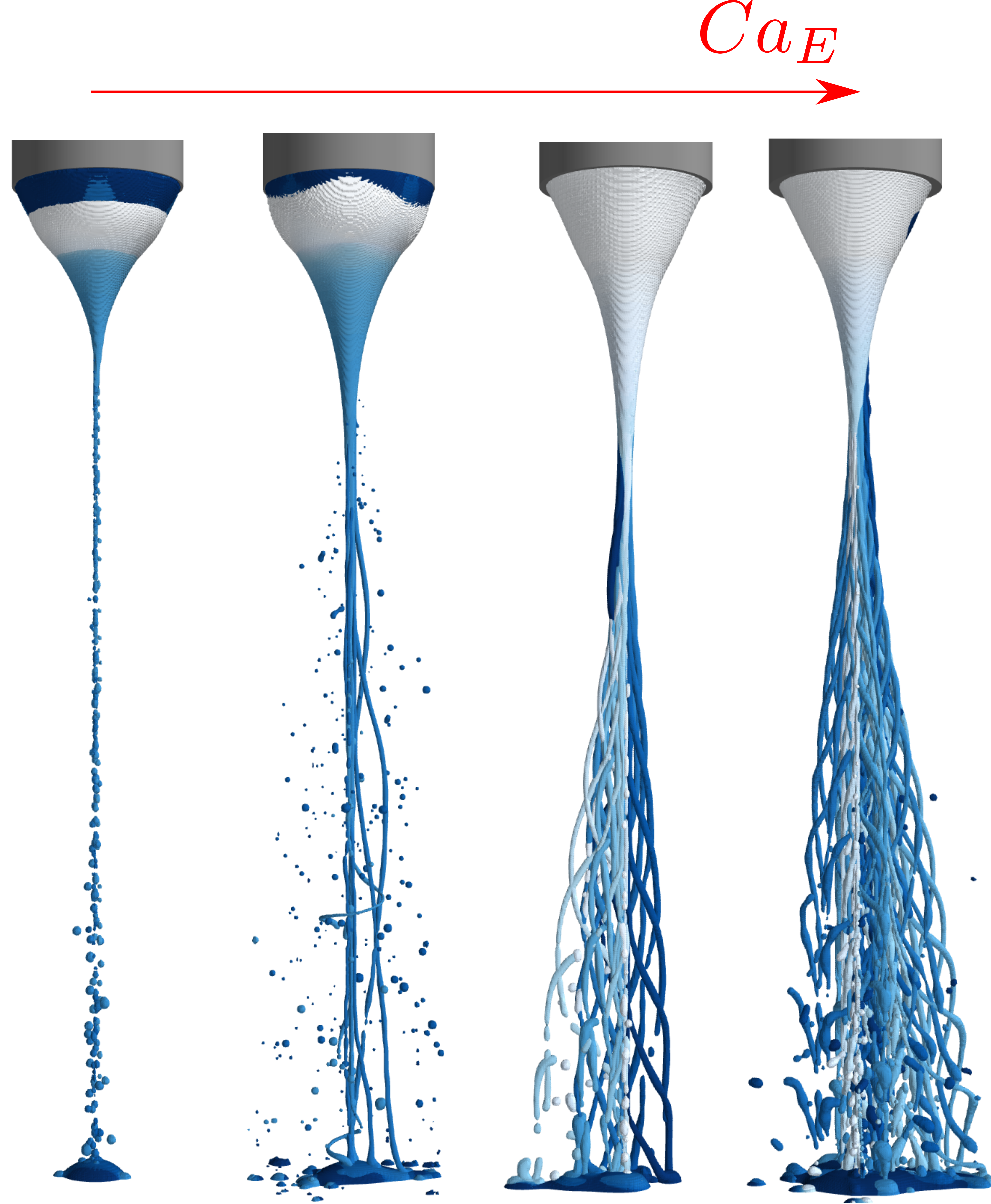
At CaE = 0.25, the jet presents a relatively stable single-droplet emission. A small increase to CaE = 0.26 produces asymmetric satellite droplets and intermittent lateral motion.
For larger values, including CaE = 0.32, 0.38 and 0.42, the jet develops increasingly pronounced radial instabilities. At the highest forcing, the jet remains continuously connected to the collector and develops a clear whipping motion.
The critical value is not universal: it depends on the geometry, flow rate, fluid properties and electrical boundary conditions.
Further Reading
A detailed description of the three-dimensional model, validation, electric-charge transport, satellite-droplet formation and whipping dynamics is available in:
S. Cândido and J. C. Páscoa, “Dynamics of three-dimensional electrohydrodynamic instabilities on Taylor cone jets using a numerical approach,” Physics of Fluids, vol. 35, 052110, 2023. View publication .